Choose the barrier.
Then the position.
A security post only helps when it blocks the route a vehicle could actually use. Start with your clear driveway opening, daily routine and surface—not a vague “heavy-duty” label.
Manual, assisted or automatic?
A manual telescopic post is the simplest option: raise it by hand, lock it and lower it into its sleeve for access. It needs no mains electricity. An assisted post reduces lifting effort. An automatic system prioritises convenience but adds power, controls and maintenance considerations.
How many posts?
Cover every usable exit route between walls, pillars and other immovable boundaries. Use our driveway post planner for a starting point, then confirm the final position from a full-width driveway photo.
Installation matters
Telescopic posts need a ground sleeve, excavation and a suitable concrete foundation. Drainage, underground services, reinforced concrete and restricted access can change the work. A responsible installer checks these before taking payment for a standard package.
What does “security” mean?
Look for specific dimensions, construction and independently verified ratings where those are claimed. POSTSECURE does not present Manual 100 as PAS 68, IWA 14 or impact-speed certified. It is a visible physical driveway deterrent.
What should the price include?
Our standard West Midlands packages include the Manual 100 post, normal installation materials, professional fitting and VAT: one £399, two £749, three £999, four £1,249, then £250 for each additional post. Site exceptions are quoted before payment.
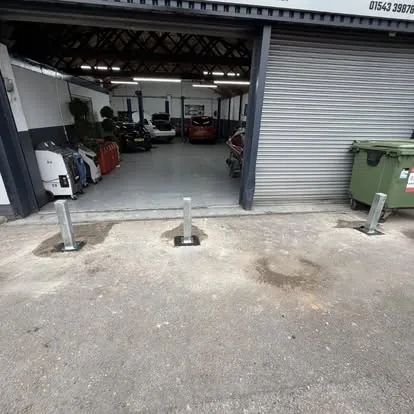
Block every usable route.
This real three-post workshop installation shows why post count follows the clear opening—not a generic one-size package. The objective is to leave no practical vehicle route around the barrier.